
Find St. Louis Unclaimed Money
St. Louis unclaimed money totals more than $173 million across over one million properties held by the Missouri State Treasurer. As an independent city that operates outside any county, St. Louis has its own massive pool of lost funds tied to residents, former residents, and businesses. The state holds these funds in trust and makes them searchable for free. Whether you lived in St. Louis decades ago or still call it home, there could be unclaimed money in your name waiting to be found. Searching takes seconds and costs nothing at all.
St. Louis Unclaimed Money Facts
Search St. Louis Lost Funds
Go to ShowMeMoney.com and type in your name. That is the fastest way to check for St. Louis unclaimed money. The site is run by the Missouri State Treasurer and works around the clock. Results show up in seconds. Each listing includes a property type and dollar amount. Click on any match to begin your claim right there on the screen.
The Missouri Treasurer's unclaimed property page links to the same search tool, plus it has background information on the program. You can sign up for email alerts that let you know when new unclaimed money shows up under your name. That way you do not have to remember to check back. The MissingMoney.com national database is another good option. It pulls records from Missouri and other states, which helps if you have moved around.
Try all the names you have used. St. Louis has a lot of old records tied to maiden names, former married names, and business names that are no longer active. Common misspellings can hide your money too. Search "Steven" and "Stephen," or "Smith" and "Smyth." A few extra searches could turn up funds you would otherwise miss.
St. Louis City Official Resources
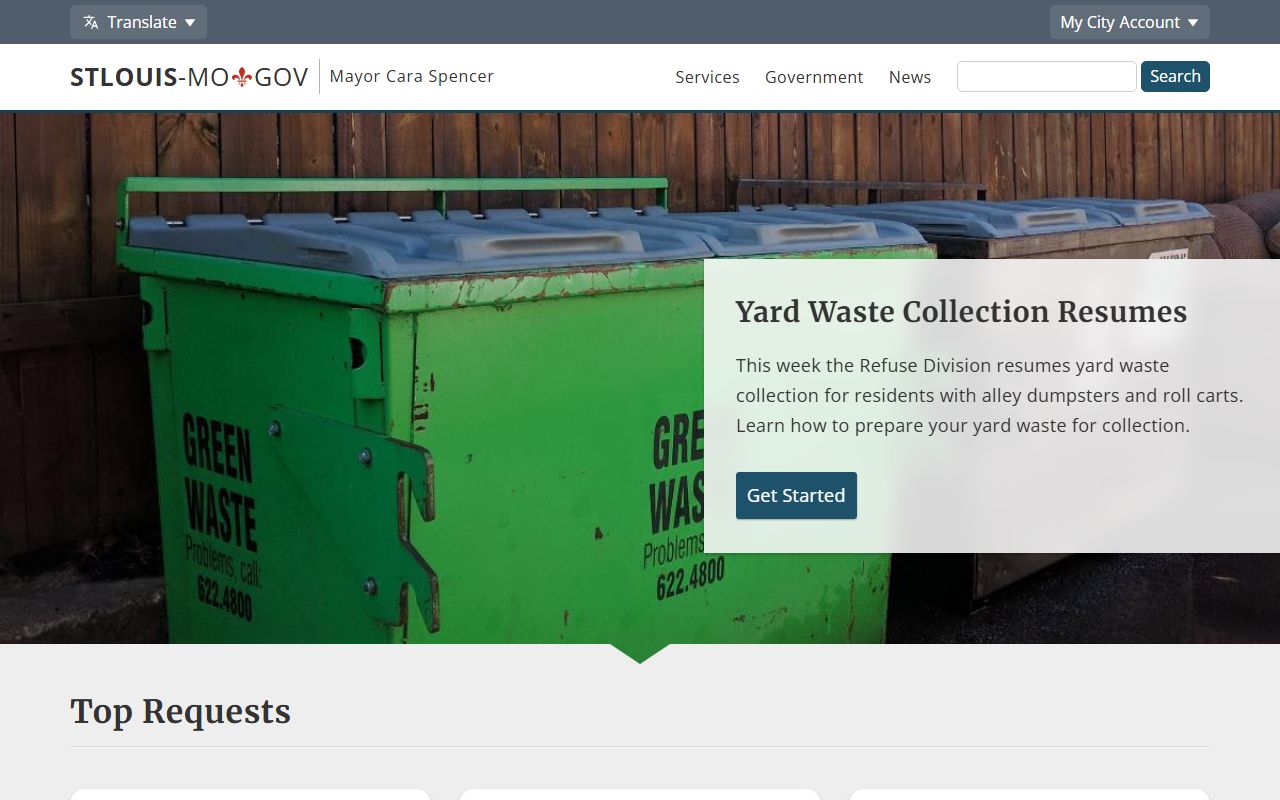
The image below shows the St. Louis City government website. While the city does not run its own unclaimed money database, several city departments handle funds that can end up as unclaimed property if they go uncollected.
St. Louis operates as an independent city in Missouri, separate from St. Louis County. This means the city manages its own finances, courts, and tax collection. Any unclaimed money from city operations flows through the State Treasurer just like every other jurisdiction in Missouri.
Types of Lost Money in St. Louis
Bank accounts that go dormant are the biggest source of St. Louis unclaimed money. When an account has no activity for five years and the bank cannot reach the owner, the balance gets sent to the state. This happens under Sections 447.500 to 447.595 RSMo. Checking accounts, savings accounts, and CDs all follow this rule. The five-year clock starts when the bank last had contact with the account holder.
Uncashed payroll checks become unclaimed after three years. Insurance payouts that never reach the beneficiary also end up in state custody. Utility deposits from old apartments and houses get reported when companies cannot find the customer. Court settlements, vendor refunds, and corporate dividends round out the list. St. Louis has a dense business environment, so the volume of unclaimed corporate funds is large.
Safe deposit boxes get turned over after five years of inactivity. These can hold anything from cash to jewelry to old documents. The state auctions off some items when no owner comes forward, but most of the value stays in the treasury as cash. Gift cards and store credits from closed St. Louis businesses also become unclaimed money.
Claim Your St. Louis Funds
Every claim is free. The state never charges to return your unclaimed money. Find your listing on ShowMeMoney.com and follow the steps on screen. Many claims can be filed entirely online with no paper forms needed. Upload a photo of your ID and any supporting documents right from your phone.
You need proof of identity. A government-issued photo ID works for most claims. The Treasurer may also want proof of your Social Security number or a former address. Larger claims may need extra documentation. If you are claiming money for a deceased family member, bring a death certificate and probate documents. Section 447.565 RSMo requires clear and convincing proof of ownership, but for the average person this just means a photo ID and maybe an old bill or bank statement.
Claims usually take 30 to 90 days to process. There is no time limit. Your money stays with the state as long as needed. The Treasurer pays up to seven years of interest on accounts that originally earned it.
St. Louis City Financial Offices
The St. Louis City Treasurer is Adam L. Layne. His office is at 1200 Market Street, City Hall Room 220, St. Louis, MO 63103. Call (314) 366-3100 for questions about city-held funds. The Comptroller's office under Donna M.C. Baringer at (314) 622-4389 handles city accounting. The Collector of Revenue, Gregory F.X. Daly, can be reached at (314) 622-4111 for tax-related matters.
The St. Louis City website has contact information for all departments. The Municipal Court at 1520 Market Street, (314) 622-3234, may hold bond refunds or court-related funds. If you had a case in St. Louis Municipal Court and never picked up a refund, that money may now sit with the state as unclaimed property.
Because St. Louis is an independent city, it does not fall under any county government. Claims are handled at the state level through the Missouri Treasurer. The county statistics page lists St. Louis City separately from St. Louis County, showing the full $173 million in unclaimed funds.
Missouri Unclaimed Money Statutes
The Missouri Uniform Disposition of Unclaimed Property Act governs all unclaimed money in the state, including St. Louis. Businesses must report dormant accounts to the Treasurer annually. The state publishes lists of unclaimed property owners and makes them searchable online. Under the law, there is no expiration date on claims. You can come forward at any time. The Treasurer's About page explains the program in plain language.
Missouri law protects claimants from being charged fees by the state. Third-party finder services may offer to locate unclaimed money for a cut of the proceeds, but you can always search and claim on your own for free. The state encourages people to go direct through ShowMeMoney.com rather than paying a service.